
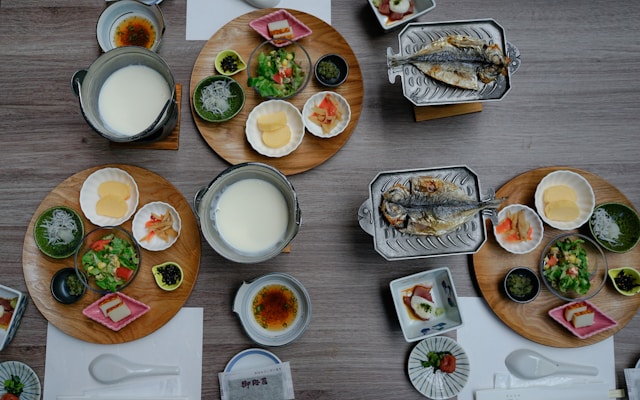
The first time I ate at a Japanese friend’s home in Fukuoka, I noticed the table before I noticed the food. Nothing matched, exactly, and yet everything belonged together. A rice bowl that fit the hand. A soup bowl with a lid. Three or four small plates, each holding something different. It looked calm and considered, and it took me a while to realize this was not a special occasion. It was just Tuesday.
That table taught me more about Japanese cooking than any recipe. Once you understand how the pieces are arranged and why, setting your own becomes surprisingly easy. You do not need a full matching dinner service, and you do not need to be a minimalist. You need a handful of the right pieces and a sense of where they go.
Here is how a Japanese table actually works, and how to build one at home.
The logic: ichiju sansai
Most everyday Japanese meals follow a quiet formula called ichiju sansai, which translates roughly as “one soup, three sides.” Add a bowl of rice, and you have the frame of the meal: rice, soup, a main dish, and two smaller accompaniments.
This matters for the table because each element gets its own vessel. Nothing is crowded onto one big plate. That is the biggest shift for anyone used to a Western table, where a single dinner plate does most of the work. In Japan, that plate is replaced by a small constellation of dishes.
Where everything goes
Placement here is not decoration. It follows a rule that has held for centuries.
The rice bowl sits at the front left. The soup bowl sits at the front right. This pairing is fixed, and swapping it reads as slightly wrong to anyone raised with it, a little like putting the fork on the wrong side of a formal Western setting. Behind those two, the main dish goes in the center or back right, with the smaller side dishes filling the space to the left and middle.
Chopsticks lie horizontally across the very front of the setting, tips pointing left, resting on a small chopstick rest so they never touch the table. That horizontal line, closest to the diner, is the detail people miss most, and it quietly changes the whole look. Western cutlery frames the plate vertically on either side. Japanese chopsticks draw one calm line in front of you.
The pieces you actually need
You can build a complete setting for one person with five items:
A rice bowl, held in the hand while eating, so weight and balance matter more than size. A soup bowl, often lacquer, sometimes lidded. A medium plate for the main dish. One or two small dishes for sides and pickles. And chopsticks with a rest.
Start there. Resist the urge to buy a matching set of twelve. Much of the beauty of a Japanese table comes from pieces that harmonize rather than match: a slightly uneven glaze next to a smooth one, a rough ceramic bowl beside a glossy plate. This is where a well-chosen shop helps more than a big-box set. When I add to my own collection, I look through curated selections of Japanese tableware and buy one or two pieces at a time, choosing things that feel right in the hand rather than things that photograph well as a set.
That slow approach is not only about looks. It keeps you from ending up with eight identical bowls you never reach for.
Materials, and how to care for them
Japanese tableware spans a few materials, and each asks for slightly different care.
Ceramic and porcelain make up most of what you will use every day. Many modern pieces are dishwasher safe, but hand washing protects glazes and hand-painted details over the long run. Lacquerware, common for soup bowls and trays, is the real exception. Keep it out of the dishwasher and away from long soaks. Wash it gently by hand, dry it straight away, and it will last for decades. I have a lacquer bowl that is older than I am and still looks the part.
Wood and bamboo, often used for serving pieces and chopsticks, also prefer a quick hand wash and an immediate dry.
None of this is demanding. It is closer to the care a good kitchen knife needs than to anything fussy.
Everyday versus company
For daily meals, keep it loose. Rice on the left, soup on the right, everything else roughly where it lands. The structure does the work, so even a casual table looks intentional.
When guests come, the same rules simply get more attention. Line up the chopstick rests. Give each side dish its own small plate instead of sharing. Add a seasonal touch: a single leaf in autumn, a sprig of something green in spring. The Japanese table has always followed the calendar, and even one small nod to the season lifts an ordinary meal.
That is really the whole idea. A Japanese table is not about owning a lot. It is about giving each part of the meal its own place, and letting simple, well-made pieces do the rest. Start with five, learn where they go, and the rest follows on its own.
