
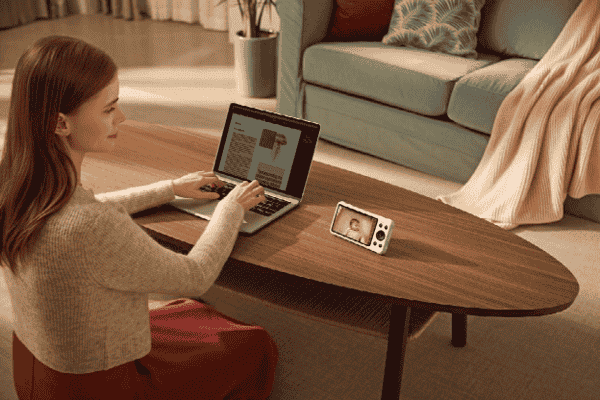
Raising young children rarely takes place in complete isolation. Across any given month, a domestic nursery may welcome a rotating cast of caregivers: parents, visiting grandparents, an occasional weekend babysitter, or a trusted family friend stepping in for an evening. While relying on an extended support network offers vital relief, coordinating the practical handover of childcare responsibilities often introduces subtle points of friction. Transferring evening duties requires communicating bedtime intervals, feeding routines, specific soothing habits, and the operation of household nursery gear. When nursery equipment introduces a steep learning curve or requires unfamiliar technical protocols, the burden of explanation escalates at the exact moment parents are attempting to walk out the door.
The Hidden Friction of Over-Engineered Nursery Devices
Over the past decade, connected nursery hardware has trended steadily toward deep smartphone integration, multi-tier companion apps, and software-centric interfaces. While digital convenience offers utility for primary caregivers managing settings over time, studies in domestic technology interaction suggest that complex digital layers frequently create barriers for secondary users. Grandparents or temporary sitters often encounter hesitation when asked to install proprietary mobile apps, create temporary accounts, navigate layered touch menus, or troubleshoot local Wi-Fi pairing issues. When an essential safety and monitoring tool requires formal technical onboarding, it redirects attention away from child engagement and injects unnecessary cognitive fatigue into evening routines.
Read more: Parental Control App for Android Tablets and Phones
Defining Practical Usability in the Shared Nursery
If nursery equipment is to serve a multi-caregiver household effectively, intuitive physical design must take precedence over software complexity. Caregivers managing an unfamiliar bedtime routine benefit most from tools that provide immediate, unambiguous visual and acoustic feedback without intermediate hurdles. What defines the easiest baby monitor to use is rarely an exhaustive catalog of niche smart settings, but rather clear physical controls, rapid visual confirmation, and an interface that is straightforward to navigate with minimal familiarization required. When a babysitter needs to verify whether an infant has settled or is beginning to stir, that information should be instantly accessible at a glance across the room, without unlocking a handset, clearing push notifications, or managing background permissions.
Digital Boundaries and Access Governance in the Home
Managing device access across different caregiving relationships also raises important considerations regarding digital boundaries and household privacy. Granting a temporary babysitter, neighbor, or visiting relative full administrative access to a family’s primary mobile applications, smart-home dashboards, or cloud-connected ecosystems is rarely appropriate. Household privacy models benefit from proportional access: temporary or local helpers require direct, immediate situational awareness while on duty, but have no need for persistent cloud credentials or continuous off-site feeds. Conversely, parents away from home often appreciate the ability to verify that bedtime has progressed smoothly without disrupting the rhythm of the caregiver on site. Harmonizing these distinct operational needs requires equipment architecture that decouples immediate local monitoring from external network access.
The Value of Frictionless Orientation and Hardware Clarity
The moments preceding a caregiver handover are inherently time-constrained, making straightforward hardware orientation an essential feature. Complicated configuration steps, hidden menu items, and obscure button arrangements frequently lead to user errors, such as accidentally silenced alarms or misinterpreted display icons. Clear, self-explanatory baby monitor setup instructions paired with responsive, dedicated hardware buttons allow visiting relatives to feel confident within moments of arrival, substantially easing the anxiety of missing an infant’s wake-up cues. When domestic monitoring gear operates intuitively upon powering up, parents can depart with peace of mind, knowing the secondary caregiver has convenient access to key visual and audio cues that support awareness of the infant’s condition without needing to troubleshoot device settings or decipher software menus.
Dual-Mode Architecture as a Case Study
Recent developments in nursery technology reflect these operational priorities by pairing dedicated physical receivers with optional external connectivity. TheMomcozy 5-Inch Dual-mode Smart Baby Monitor serves as a representative case study of how dual viewing pathways accommodate distinct caregiving contexts simultaneously. In this arrangement, a local grandparent or babysitter relies entirely on a dedicated 5-inch parent unit, gaining instant, full-room visibility and reliable audio through direct local transmission—completely bypassing the need to download software, connect a personal phone, or log into a wireless network. Concurrently, parents away from the house can monitor the nursery feed and receive motion alerts through integrated baby monitor app functionality, maintaining remote reassurance without altering the physical unit in use at home. By cleanly separating on-site hardware operation from mobile streaming, the system meets the practical requirements of both local supervision and remote parental awareness.
Designing for Household Resilience and Calm
Domestic nursery technology functions at its best when it operates quietly in the background rather than demanding active technical management. Evening routines with infants and toddlers are inherently delicate, and secondary caregivers already bear the responsibility of adapting to unfamiliar household rhythms and soothing protocols. Equipment designed with direct physical interfaces, straightforward audio and visual feedback, and sensible access divisions minimizes operational friction across the entire care circle. By prioritizing accessibility and thoughtful hardware simplicity over gratuitous technical complexity, households create an environment where shared caregiving feels collaborative, calm, and dependable for everyone involved.
