
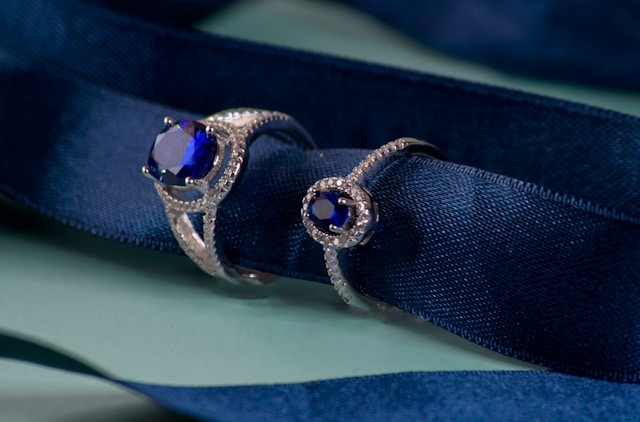
Walk through any engagement announcement feed this year, and something has shifted. Alongside the familiar solitaires and pave halos, a darker, moodier style keeps appearing: dark center stones, blackened settings, and silhouettes that borrow from architecture and antiquity rather than from the same handful of bridal templates. Gothic engagement rings, once a niche request whispered to a jeweler, have moved into open conversation. This is a look at why that is happening now, what cultural currents are feeding it, and who tends to gravitate toward the style.
The move away from conventional bridal
For a long time, the engagement ring followed a narrow script. A clear stone, a bright metal, a shape chosen from a short menu. That script still works beautifully for many people, but a growing number of couples want a ring that reads as theirs before it reads as a category. Gothic engagement rings answer that impulse directly. They keep the emotional weight and permanence of a traditional ring while swapping the visual language for something with more shadow and character. The result feels intentional rather than default. Brands built around distinctive design, such as Aquamarise.com, have noticed that shoppers increasingly arrive already knowing they want something outside the usual bridal aisle, and they are comfortable saying so.
Dark romance as an aesthetic
The phrase people reach for again and again is dark romance. It captures something the traditional bright solitaire cannot: the idea that love has depth, mystery, and a little edge. A darker palette does not read as gloomy in person. Instead, it reads as considered and quietly dramatic. Deep-toned stones catch light differently than colorless ones, holding a pool of shadow at the center that draws the eye inward. Blackened or oxidized detailing frames that stone the way a heavy curtain frames a stage. For couples who feel that a purely bright ring does not match their personality or their relationship, this aesthetic offers a way to signal commitment without sanding off every rough and interesting edge.
Read more:
1. The Structured Brilliance of a 1 Carat Princess Cut Diamond Ring
2. What is a Darry Ring? Everything You Need to Know It
3. How to Build a Signature Jewellery Look
4. The Hidden Spiritual Meaning of Rings on Fingers
The influence of film and fashion
No trend arrives in a vacuum. The current appetite for gothic engagement rings has been fed by a steady drip of visual culture. Prestige television and film have leaned into moody, romantic period settings full of ornate metalwork and low candlelight. Runways have cycled through their own dark-romantic phases, pairing lace, corsetry, and heavy silver with an unmistakably modern attitude. Music and celebrity culture add another layer, with high-profile figures choosing unconventional rings and turning them into talking points overnight. None of these forces dictates what a person picks, but together they normalize the idea that a serious ring can be dark, ornate, and unafraid. What once looked subversive now looks styled.
A dark center stone gives an engagement ring a gothic edge.
Individuality as the real driver
Strip away the mood boards and the deeper reason this category is growing comes into focus: people want their ring to be recognizably their own. A gothic engagement ring is hard to mistake for anyone else’s. The design choices carry meaning, whether that is a nod to a shared love of old architecture, a favorite era of art, or simply a refusal to wear what everyone else is wearing. This is where independent and design-led jewelers tend to shine, because the style rewards makers who treat a ring as a small piece of personal storytelling rather than a stock item. Shoppers exploring gothic engagement rings are usually not chasing a trend for its own sake. They are looking for an object that matches who they already are.
A few things tend to define the look without narrowing it too far:
- A darker or unexpected center stone that anchors the design with depth.
- Settings with ornate, architectural, or antique-inspired detailing.
- Contrast between the stone and a cool-toned or oxidized metal.
- Silhouettes that feel sculptural rather than strictly symmetrical.
How it photographs
Part of the reason this style spreads so quickly is that it performs unusually well on camera. Bright solitaires can wash out under phone flash and blend together across thousands of near-identical posts. A gothic engagement ring does the opposite. The contrast between a deep center stone and its setting reads clearly even in a small thumbnail, and the shadows give the image a sense of depth that a flat, bright stone struggles to match. In natural light the effect is quieter but no less striking, with the darker tones shifting as the hand moves. For a generation that documents milestones visually, a ring that holds its character on screen is not a shallow consideration. It is part of how the story gets told and shared.
Who it suits
The obvious assumption is that this style belongs only to people with a fully gothic wardrobe, and some wearers do lean that way. But the appeal is broader than the label suggests. Plenty of people who dress in soft neutrals or classic tailoring choose a dark, dramatic ring precisely because it becomes the single unexpected note in an otherwise understated look. It suits anyone who wants their jewelry to carry a point of view: readers, romantics, history lovers, and anyone drawn to contrast. Because the category spans everything from subtle to boldly ornamental, it accommodates a wide range of comfort levels. Someone can dip a toe in with a single dark accent or commit fully to an elaborate, storybook silhouette. The style meets people where they are.
A moment with staying power
Trends usually burn bright and fade, but the forces behind gothic engagement rings look more durable than a passing fad. They sit at the intersection of two lasting desires: the wish for a ring that signals real commitment, and the wish to express individual identity rather than follow a template. As long as both of those hold, there will be room for engagement rings that trade brightness for depth and convention for character. The takeaway is not that everyone should choose a dark ring. It is that the definition of a meaningful engagement ring has widened, and gothic designs are one of the clearest signs of how far it has stretched.
